As a result
of industrial development and population growth, previously a very big increase
in requirement of energy has been in demand. (In opposition of enhancement in
energy production) Consequently, the source of energy is limited than the real
requirement and so the energy crisis has developed.
Consistent Rise in Demand for Energy
The issue of adjusting with Pakistan’s energy supply in opposition of
the requirement for electricity has always been left as a un- resolved issue,
for years and years. In these many years, Pakistan has always been suffering by
serious energy shortages, with electricity cuts up to 20 hours a day. The
country has fixed an electricity capacity of 22,797 megawatts (MW), but
production yet still stands at a dismal 12,000 MW. Recently, the requirement of
electricity has gone up to 28,029 MW.
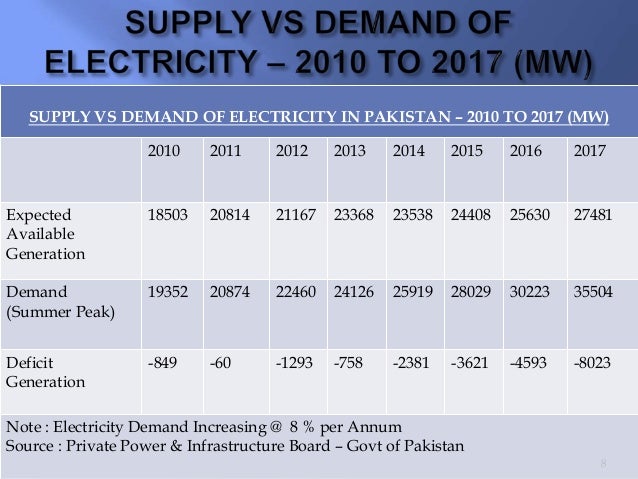
Sources of Power generation
- Fossil Fuels (coal, natural gas and oil)
- Nuclear Power
- Renewable Sources
- Hydro power
- Solar power
- Tidal power
- Wind power
- Fossil Fuels:
These are sources of energy which are non- renewable as they are borrowed from pre-historic fossils and will not be accessible once they are fully worn.The Fossil fuels has a power generation of 65% of total power production.
A total of 51 MoU's were signed in diverse sectors between China and
Pakistan during the visit of Chinese president to Pakistan on 20 April
2015

Major coal-related projects under the corridor umbrella are:
- Financing cooperation agreement between the EXIM Bank of China and Port Qasim Electric Power Company (Private) Limited on Port Qasim EPC power station,
- Gwadar Port - Completed, handed over to China for 40 years starting 2015
- Agreement on Port Qasim EPC power station between Power China and GoP
- Cooperation agreement on Hubco power station between CPIH and Hubco Power Company
- Nuclear power:
Nuclear power is too expensive, dangerous and insufficient; it is not
an acceptable answer or solution to the country’s energy problems. Nuclear
plants take too much time to build to solve any quick energy needs and are too
expensive to be a competent solution in the energy market place. People in
favour of nuclear power do not see or consider the big dangerous risks. They
fail to see the cheaper and more efficient non- nuclear options which are also
in the market place. The total power production in Pakistan, only 4% is the
power generation of Nuclear Energy.
- Renewable Sources:
Hydro Power:
In Pakistan, Hydro power is a rich source of energy which produces
31% of total electricity generation.China's state-run power company, Three Gorges Corporation (CTG), is
keen to participate in financing consortium to fund up to $50 billion of
hydroelectric power projects in Pakistan

Major Hydro Power projects are
- Dasu hydro power stage-I project
- Gulbur hydro power project in Pok
- Neelum-Jhelum Hydropower plant
Solar Power:
"Pakistan is the link between the belt and the road...
In Pakistani Kashmir, Punjab,
Sindh and Balochistan- Pakistan is building solar power plants. This program is
under development by the International Renewable Energy Agency,China and Pakistani
Private Sector Energy Company. The world’s largest Single Solar
photovoltaic power plant in Pakistan was built by the Chinese company-TBEA
Xinjiang Sun Oasis & Co.
Global deployment figures
|
|
|||||||||||||||||||||||||||||||||||||||||||||||||||||||||||||||||||
| Data: IEA-PVPS Snapshot of Global PV 1992–2014 report, March 2015[4] | ||||||||||||||||||||||||||||||||||||||||||||||||||||||||||||||||||||


 Tidal Power:
Compared to other renewable energy technologies, Tidal power has not
yet been operational in Pakistan but in the near coming future it might play a
key role.
Wind Power:
Wind Power:

In Bin Qasim, Keti Bandar, Jhimpir and Gharo in Sindh- Pakistan is
developing wind power plants.
The government of Pakistan decided to develop wind power energy
sources because of problems supplying energy to the southern coastal regions of
Sindh and Balochistan, with assistance from the government of China the project
was undertaken. With potential, another area is Swat which shows good wind
conditions in wind power investment. In the Nukundi area near the Afghan/Iran
Border, the Chagai District in Balochistan has good potential for wind power-
with wind speeds of often 12.5% higher than average required for energy
generation.
Some examples are:
Jhimpir Wind Power Plant (operational)
Gharo Wind Power Plant (operational)
Bin Qasim Wind Power Project (under construction)
Source of Fuel used in power generation
Source of Fuel used in power generation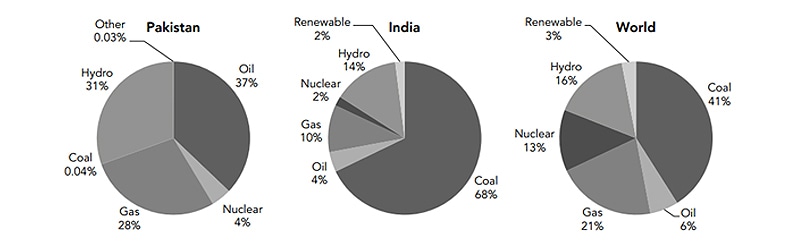
Causes of Energy Crisis:
Pakistan is facing serious energy crisis for the last few years, which
is taking a heavy toll on the trade & industry as well as on the overall
economy. Major causes are as under:
- Cash flow problems are created in the supply chain because of circular debt
- Because
of lack of investment, old transmission network suffers severely.
- No public investment in the thermal power has encouraged as the sector was to be privatized. As a result, power plants in public sector are producing far less power than their actual capacity.
- Power theft and under recovery of bills by DISCOs reportedly translate into a loss of Rs.260 billion to the power sector and discourages investment in the sector.
- In the winter season when the
country faces extreme shortage of gas, government normally cuts down the gas
supply to power sector in order to meet the demand of domestic users and
selected fertilizer companies, which reportedly causes a loss of USD 400
million to the power sector and causes shortage of energy generation.
Recommendations:

- Pakistan should focus on the utilization of hydroelectric resources through the buildings like Kala Bagh Dam, Basha Dam etc. to make cheap electricity.
- It should enhance affiliations with the international and Regional Corporation.
- It should stimulate the coal project alongside the assistance of China to address an energy crisis.
- It should use new policies to overcome the problem through renewable energy resources i.e. Solar, Wind and Tidal energy.
- It should take positive actions to come to an end to international gas pipe line projects i.e. IPI (India, Pakistan, Iran)-Gas pipe line project which meets the needs of gas requirements of Pakistan and possibly India.
- Finally, it should make the effort to fulfil the needs of the project TAPI which was developed by Asian Development Bank.
Summing up:
Energy requirements are forever joined to Pakistan’s economic and
sustainable growth capabilities. Across particular areas of energy sources,
Pakistan has been increasing in demand. Because of the number of increasing
economy and the request of vast production and input across the country, the
energy requirement still is very high. As of the requirement of energy, to
promote renewable energies, various energy sources and energy efficiency-
Pakistan is doing the best possible.
